


Strong Governance: The Key to Africa’s Carbon Market Growth
Key Words: Carbon Market, Carbon Governance, Climate Finance
Africa contains some of the world’s most important carbon sinks. Its forests, wetlands, savannahs, and agricultural areas sequester billions of tonnes of CO₂ each year. The Congo Basin is the second-largest tropical rainforest globally. West Africa’s coastal mangroves, gallery forests, and cocoa agroforestry systems also store significant amounts of carbon. As a result, Africa is well positioned to become a major supplier in global voluntary and compliance carbon markets and to generate the finance needed for its climate transition.
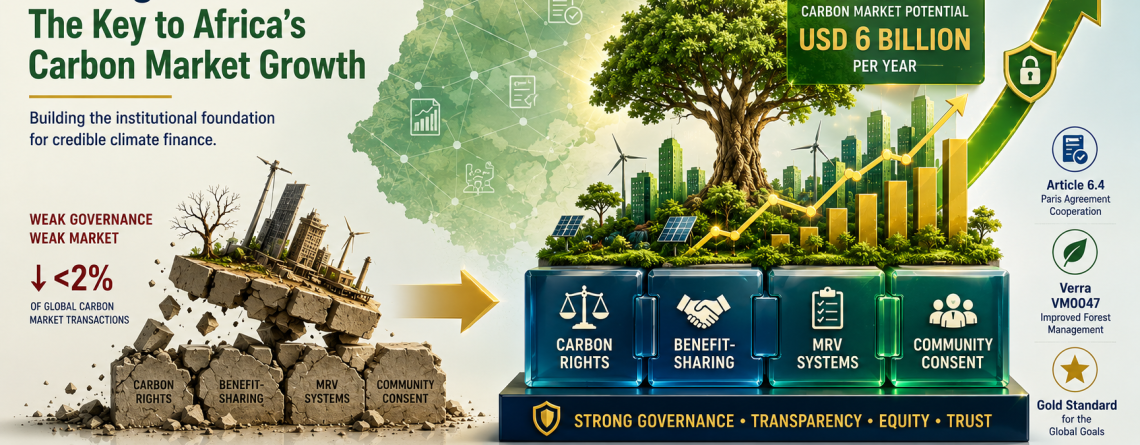
Recent developments support this opportunity. With the agreement on Article 6.4 of the Paris Agreement at COP29, a regulated international carbon market is now operational. This enables African countries to trade verified emissions reductions with wealthier nations and corporations. The African Carbon Markets Initiative aims to generate 300 million carbon credits annually by 2030, potentially mobilizing over USD 6 billion per year for the continent.
However, African countries account for less than 2% of global carbon market transactions. The gap between carbon potential and carbon finance is due to institutional, not geological, factors.
The Core Structural Constraint
A clear assessment is necessary: Africa’s main constraint in carbon markets is not a lack of carbon, but a lack of effective governance.
Across the continent, carbon market participation is limited by structural weaknesses: unclear land tenure and carbon rights, underdeveloped national carbon registries, fragmented regulatory authority, and a lack of standardized frameworks for project validation, benefit-sharing, and community consent. Without these foundations, credible carbon projects cannot be developed, verified, or traded at scale, regardless of the carbon stored.
The governance deficit appears in several ways. In many jurisdictions, it is unclear whether carbon rights are linked to land ownership, resource-use rights, or state sovereignty. Some governments have signed and later cancelled carbon agreements with private developers without clear legislative support, exposing both parties to legal and reputational risks. Community benefit-sharing arrangements are often poorly documented, increasing the risk of elite capture. Monitoring, reporting, and verification systems are frequently absent or rely entirely on external consultants, limiting domestic oversight.
This issue is central to why carbon finance has not reached Africa at the scale warranted by its natural assets.
Putting the House in Order: Lessons from Nigeria and Liberia
West Africa demonstrates both the extent of the governance gap and the initial efforts to address it.
Nigeria, the continent’s largest economy, has significant carbon assets in its Niger Delta mangroves, Cross River Forest zone, and agricultural landscapes. The government has prioritized carbon market engagement through its updated NDC and the Nigerian Carbon Market Activation Policy. However, the policy framework is fragmented. Oversight is divided among the Federal Ministry of Environment, the Nigerian Meteorological Agency, and sector-specific regulators, with no single authoritative registry or benefit-sharing code. As a result, project developers face lengthy approval processes, communities lack enforceable rights, and international buyers are cautious about the legal permanence of credits from Nigeria.
Liberia offers a more pronounced example. With over 40% forest cover and significant biodiversity, it has attracted considerable interest from carbon project developers, especially in the voluntary market. However, Liberia’s regulatory framework has struggled to keep pace. The Liberia Carbon Markets Authority, established in 2023, is a positive step, but its mandate, technical capacity, and coordination with the Forestry Development Authority and other regulators are still developing. Concession agreements for forested land have often lacked adequate environmental and social safeguards, and community land rights under customary tenure remain legally uncertain. Several high-profile voluntary carbon projects in West Africa, including Liberia, have faced scrutiny regarding additionality, community consultation, and baseline assessment credibility.
Both cases highlight the same lesson: carbon market integrity cannot be added to weak governance. It must be integrated into regulatory frameworks from the outset, requiring technical investment, institutional design, and enforcement capacity that most West African governments currently lack.
What Credible Carbon Market Development Requires
Closing the governance gap is achievable, but it requires a deliberate and sequenced approach. Three priorities are essential.
First, governments should establish clear carbon rights legislation. They must define in law who owns carbon and under what conditions it can be transacted, clarifying the relationship between state sovereignty, landowners’ rights, and community customary tenure. Without this, project developers cannot provide buyers with the legal certainty required for credible credits.
Second, countries should develop functional national registries and MRV systems. Measurement, Reporting, and Verification must be a domestic technical capability, not an externally contracted activity. This requires investment in personnel, data infrastructure, and regulatory standards aligned with Verra VM0047, the Gold Standard, and the evolving Article 6.4 rulebook. Countries with this capability will be better positioned to negotiate the terms for their carbon in international markets.
Third, governments and project developers should implement enforceable benefit-sharing frameworks. Carbon projects that displace or exclude local communities create controversy, legal challenges, and undermine market credibility. Community consent protocols, transparent revenue-sharing arrangements, and grievance mechanisms with legal standing must form the foundation of project legitimacy.
Final Reflections
Africa faces a governance problem, not a carbon problem. The continent’s carbon assets are substantial, its mitigation potential is significant, and the post-COP29 regulatory environment has improved the international framework for African credits. However, sustained carbon finance will only materialize if the necessary institutional infrastructure supports credible, transparent, and equitable market participation.
In West Africa, the opportunity to address these issues is limited. As voluntary carbon markets mature and buyer scrutiny increases, only projects with clear rights, robust MRV, and genuine community beneficiaries will attract investment.
This is the focus of Ceidra’s work: we support governments, NGOs, and private-sector actors across West Africa in building the technical and institutional foundations for credible carbon markets. Our services include regulatory framework reviews, carbon rights analyses, MRV system design, benefit-sharing structures, and biodiversity co-benefit assessments. We do not offer carbon credits; we create the governance conditions necessary for credible carbon markets. This work is urgent.
Ceidra Consulting Ltd. offers specialist advisory services in ESG, biodiversity risk, conservation finance, and sustainable land use throughout West Africa.
For enquiries, please contact enquiries@ceidrang.com.
Comment (1)
Enjoy the read every single day.