


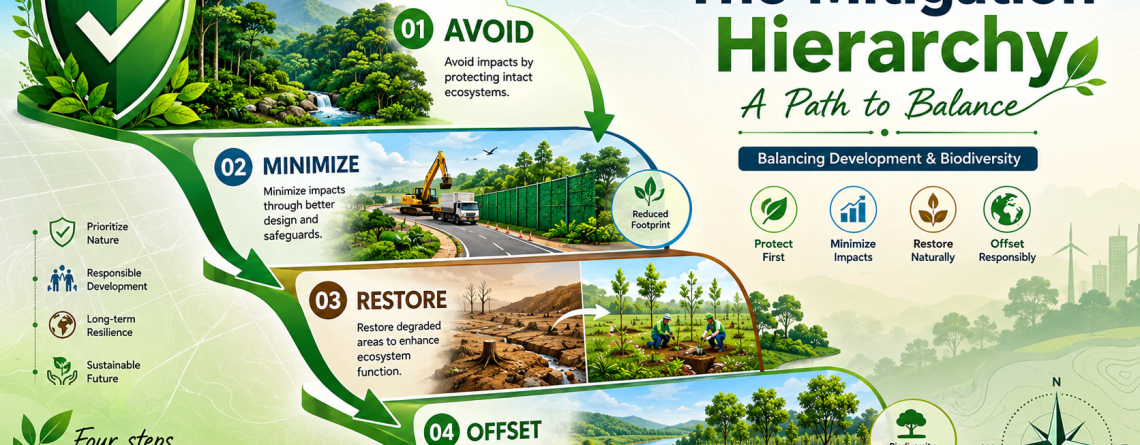
The Mitigation Hierarchy: A Path to Responsible Development
- Overview
The Mitigation Hierarchy (MH) is a structured framework for addressing the environmental and social impacts of development. It follows a strict sequence: avoid, minimise, restore, and, if necessary, offset. MH recognises that sectors such as agriculture, mining, infrastructure, and energy can affect ecosystems and livelihoods; thus, it emphasises proactive planning and prioritising harm prevention before compensation.
This framework is widely used to balance economic growth with environmental protection and community well-being. It underpins global No Net Loss and Net Positive Impact agendas and is embedded in IFC Performance Standard 6, the Equator Principles, and national EIA (or ESIA) regulations. As commitments to biodiversity conservation and climate resilience grow, MH is increasingly vital for responsible investment and sustainable development.
- Context and Challenges
Development projects generate social and economic opportunities, but they also contribute to deforestation, habitat loss, biodiversity decline, land degradation, and social conflicts.
Historically, environmental management has focused on rehabilitation and compensation after impacts have occurred, rather than on prevention. As a result, offsetting is often used as a first rather than a last resort, with developers bypassing avoidance, minimisation, and restoration. This misapplication undermines the logic of the mitigation hierarchy and is further weakened by poor baseline data and institutional gaps.
As a result, it is increasingly difficult to demonstrate credible environmental and social responsibility as ecosystems and species remain unrecovered, and social impacts become long-lasting for affected communities.
- Why It Matters
The Mitigation Hierarchy follows a clear sequence:
- Avoid: Prevent impacts by changing project design, location, timing, or methods.
- Minimise: Reduce impacts that cannot be entirely avoided through improved operational practices.
- Restore: Rehabilitate affected ecosystems and social conditions.
- Offset (or compensate): As a last resort, implement measures that compensate for significant residual impacts.
This sequence is important because preventing damage is usually more effective and less costly than repairing it. Inconsistent application accelerates biodiversity loss, while poor sequencing leads to avoidable loss of resources and livelihoods for communities. Furthermore, offsets implemented without free, prior, and informed consent increase both social and environmental risks.
For businesses, failing to demonstrate rigorous avoidance and minimisation now poses a significant financing risk. Compliance with the Mitigation Hierarchy is considered a due diligence requirement, not just a reputational concern.
For governments, weak enforcement undermines national biodiversity strategies and NDC commitments, and increases reputational and legal risks, especially if projects are later found non-compliant with lender safeguards.
- Our Perspective and Approach
Ceidra Consulting recognises the Mitigation Hierarchy as a practical tool for integrating conservation and development objectives. Environmental protection should be an integral part of planning and investment decisions, not an afterthought.
Effective application requires robust environmental assessments, stakeholder engagement, spatial planning, and evidence-based decision-making. Collaboration among governments, communities, the private sector, and development partners is also essential.
In landscape programmes and sustainable commodity systems, the framework guides decisions on agricultural expansion, identifies areas in need of protection, and informs investments that support both livelihoods and ecosystem integrity.
The Mitigation Hierarchy complements broader approaches such as integrated landscape management, nature-based solutions, sustainable finance, and environmental, social, and governance (ESG) frameworks.
- Key Actions and Opportunities
Effective application of the Mitigation Hierarchy reduces environmental risks and supports resilient livelihoods, responsible investment, and long-term sustainability. It requires:
- Integrating environmental and social considerations early in project planning.
- Using spatial data and risk assessments to identify sensitive areas and avoid high-risk locations.
- Strengthening environmental and social impact assessment processes.
- Building institutional and technical capacity to implement mitigation measures.
- Promoting meaningful participation of affected communities and stakeholders.
- Encouraging private sector adoption of good environmental and social practices.
- Developing monitoring systems to track mitigation performance and outcomes.
- Conclusion
The Mitigation Hierarchy offers a practical, systematic approach to managing the environmental and social impacts of development. By prioritising avoidance and minimisation over restoration and compensation, it supports informed decisions that protect ecosystems, reduce risks, and promote sustainable development.
As regulatory and market pressures related to biodiversity-linked finance increase, the costs of weak mitigation sequencing for communities, government credibility, and business access to capital will rise. Rigorous application of the Mitigation Hierarchy is essential to align economic development with biodiversity conservation and social responsibility, ensuring development supports human well-being and the long-term viability of nature.
Comments (2)
Great content! Keep up the good work!
Great post,Thanks for sharing