


What ESG Means: 3 Essential Pillars for Businesses
Environmental, Social, and Governance (ESG) has become central to business sustainability. Investors, banks, and governments increasingly require ESG compliance. Yet many still ask what ESG means. This article outlines what ESG covers, how it differs from Corporate Social Responsibility (CSR), and its practical application.
What Exactly is ESG?
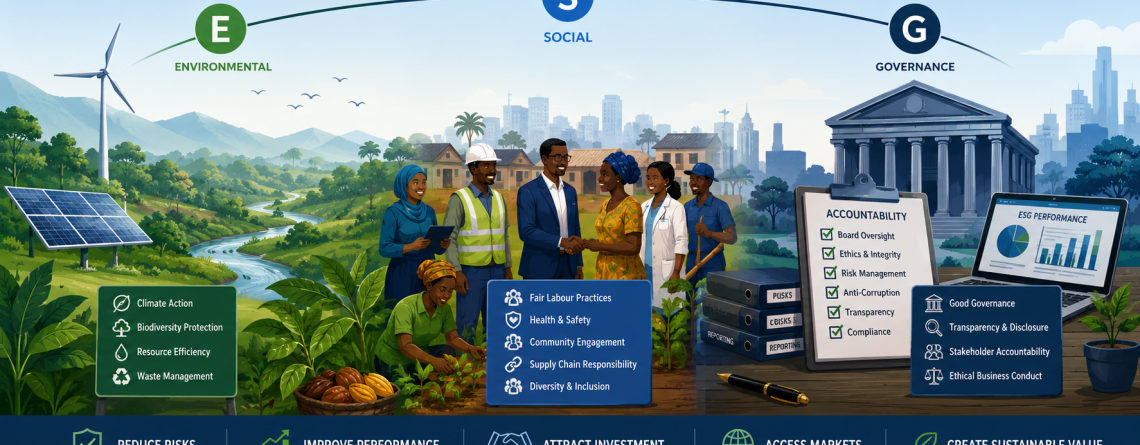
ESG is not merely another reporting requirement or a new term for CSR; it is a practical approach to managing risks, improving performance, and creating long-term value by addressing environmental, social, and governance issues. Investors, customers, regulators, and international markets now use ESG to assess the long-term sustainability of businesses.
The 3 Essential Pillars
The Environmental pillar evaluates how a business impacts and relies on natural systems. Key questions include: How much energy does the company use? Does it manage waste responsibly? Does it protect forests, biodiversity, and water resources? Is it reducing pollution and greenhouse gas emissions?
The Social pillar considers how a company treats employees, suppliers, customers, and communities. This includes fair labour practices, worker health and safety, human rights, gender equality, community engagement, and responsible supply chains. Social performance is now as important as product quality.
Governance focuses on how a company is managed to ensure decisions are responsible, transparent, and ethical. It includes board oversight, ethical conduct, anti-corruption measures, financial transparency, risk management, and compliance with laws and regulations. Strong governance builds trust with investors, lenders, customers, and regulators.
ESG Is Not CSR
A common misconception is that ESG is simply another name for CSR. However, they serve different functions.
CSR are voluntary philanthropic initiatives that demonstrate social commitment but are often separate from a company’s core strategy. Examples include donating to schools, supporting local communities, or sponsoring public events.
ESG, by contrast, focuses on how the business operates. It considers whether the company manages environmental risks, treats people fairly, and maintains strong governance systems.
Essentially, ESG addresses how business is conducted, not just what is given back. Companies that treat ESG as philanthropy may struggle to meet expectations, as due diligence teams seek measurable indicators rather than narrative commitments.
Applying ESG
While ESG is often associated with Europe or North America, its importance is rapidly increasing across Africa. African businesses face unique sustainability challenges compared to those in developed countries.
For example, an agribusiness may need to address deforestation and child labour, or a mining company may need to focus on biodiversity conservation and community relations. A commercial bank may need to assess climate risks when financing projects, or a manufacturing company may need to improve energy efficiency and waste management.
These issues are unique because materiality varies; therefore, ESG practices should not be copied directly from international templates or other companies. Instead, ESG should be tailored to address the most relevant issues for each company’s operations and stakeholders. This is the starting point for any business seeking to apply ESG effectively.
The following steps will help ensure your ESG report meets stakeholder expectations and aligns with your operations.
Step 1 – Begin with a materiality assessment to identify which environmental, social, and governance issues are most significant. A guide to performing a materiality assessment can be found here.
Step 2 – Prioritise the indicators identified as significant in the materiality assessment, rather than attempting to report on all issues simultaneously.
Step 3 – Align with a recognised standard. The Global Reporting Initiative (GRI) is the most widely used reference for structuring disclosures after identifying priority issues.
Step 4 – Embed ESG in decision-making and treat ESG indicators as inputs to strategy, not solely for reporting.
Why It Matters
Globally, investors and financial institutions are paying closer attention to sustainability, including ESG risks. ESG is no longer confined to multinational corporations or listed companies. It is becoming essential to how businesses are financed, managed, and evaluated.
Successful companies will move beyond viewing ESG as a compliance exercise and use it as a tool for better decision-making, stronger risk management, and sustainable growth.
Understanding ESG and applying it in a locally relevant way is now essential. Those who begin this journey today will be better prepared for tomorrow’s opportunities and challenges.
Ceidra Consulting supports businesses across Nigeria and West Africa in developing materiality assessments, ESG strategies, and biodiversity risk frameworks tailored to local contexts. We also help organisations create long-term value while meeting evolving market and regulatory expectations.
Comment (1)
Nice read and easy to understand.