


How to Finance Nature-positive Agriculture in West Africa
Overview
Nature-positive agriculture not only produces food but also restores the landscape (soils, water, biodiversity, and forests). It delivers measurable ecological benefits alongside productivity. In West Africa, where agriculture employs most of the workforce and drives deforestation, this transition is both urgent and economically justified. The primary barrier is financial, not a lack of knowledge or ambition. Small-scale farmers, cooperatives, and agribusinesses struggle to access the long-term capital required for nature-positive practices. Addressing this gap requires a mix of financial instruments, reliable outcome metrics, and financing tailored to the region’s value chains.
Context and Challenges
West African agriculture faces multiple pressures, including soil degradation, irregular rainfall, expansion of farms, and increased exposure to deforestation. Nature-positive solutions like agroforestry, regenerative soil management, and forest-friendly commodity production are available, but financial support remains insufficient.
Traditional agricultural lending views ecological practices as risky rather than valuable. Loans are typically short-term, have high interest rates, and require collateral, excluding most smallholder farmers. Transition costs are immediate, while benefits such as improved soil fertility and carbon accumulation accrue over time. Limited public budgets and private investors’ perception of high risk mean there are few financial instruments to address this timing and risk mismatch. As a result, nature-positive agriculture remains underfunded despite its clear returns.
Why It Matters
Financing this transition is a strategic priority for three reasons.
- Buyers and regulators increasingly require deforestation-free, traceable commodities. Producers without adequate financing risk exclusion from premium export markets.
- Resilience: Degraded landscapes reduce yields and increase vulnerability to climate change, threatening rural incomes and national food security.
- Capital mobilization: Nature-positive agriculture could attract climate finance, biodiversity finance, and impact investment, which the region currently misses due to a lack of viable financial structures.
Without financing, degradation will continue, competitiveness will decline, and access to growing pools of sustainability-linked capital will be lost.
Our point of view and approach
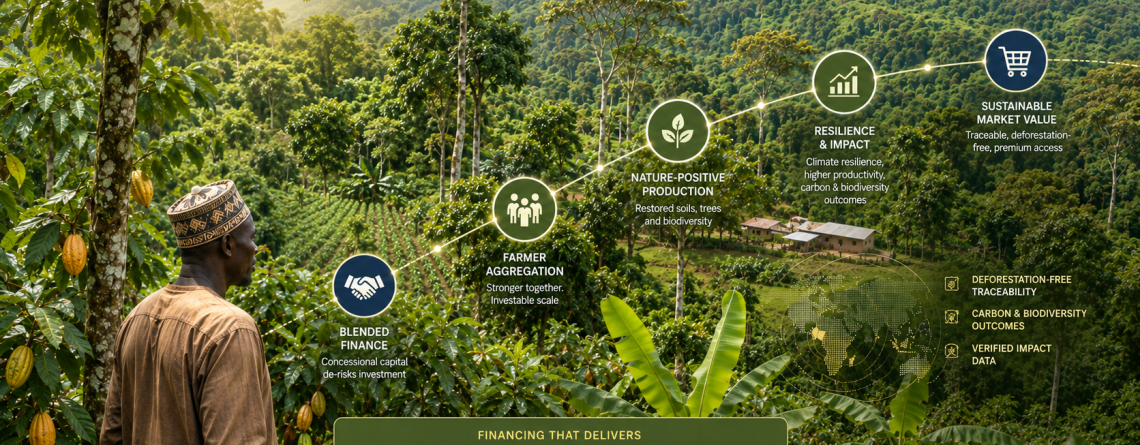
Ceidra views nature-positive agricultural finance as a multi-layered system, aligning each type of capital with its appropriate level of risk and return.
- Blended finance uses public and philanthropic capital to assume initial risks, encouraging commercial investment in the sector.
- Value-chain finance links smallholder financing to secured demand for sustainable commodities through offtake agreements and buyer-backed credit.
- Income from carbon and biodiversity credits, generated through agroforestry and soil carbon, depends on credible monitoring and equitable benefit-sharing.
- Green and sustainability-linked lending ties interest rates to verified environmental performance, rewarding measurable progress.
- Cooperatives and landscape funds aggregate smallholders to achieve investable scale and reduce transaction costs.
Effective organization of these tools requires linking them to specific metrics, implementing strong safeguards, and following the mitigation hierarchy to ensure financial actions deliver real ecological benefits.
Key Actions and Opportunities
Mobilizing nature-positive agricultural finance in West Africa requires coordinated action:
- Establish blended finance facilities to reduce risks for private investment in transition agriculture.
- Develop bankable project pipelines using credible baselines and verifiable outcome indicators.
- Strengthen farmer aggregation to achieve investable scale and reduce delivery risk.
- Incorporate deforestation-free traceability to secure access to premium markets.
- Enhance the technical capabilities of banks and cooperatives to assess and manage nature-linked finance.
- Align national agricultural and climate policies to encourage ecological outcomes.
Conclusion
Nature-positive agriculture enables West Africa to achieve secure food systems, resilient livelihoods, and global market competitiveness. The methods are established; financing remains the main barrier. Combining concessional and commercial capital, linking finance to verified results, and aggregating smallholder farmers into investable structures will direct climate and biodiversity funds toward productive, restorative land use. As deforestation regulations tighten and sustainability-linked finance expands, the cost of inaction rises. Establishing nature-positive finance now will secure lasting value for West African agriculture.
Ceidra Consulting supports governments, financial institutions, and agribusinesses in Nigeria and across West Africa to design blended finance structures, conservation finance strategies, and biodiversity risk frameworks, directing capital toward nature-positive outcomes.
Leave a Reply